Archive

April 2024

Browsing

 ‘Good fences make good neighbors.’ – Robert Frost.

We teach people how to treat us, knowingly or unknowingly. We allow people to treat us unfairly because they are our childhood friends, family members or the only friends we have. It is tough setting boundaries for our closest family members and long-time friends because it is not easy but at some point, one has got to draw the line. By setting healthy boundaries, we can have a mutually beneficial relationship, but we fear and don’t want to rock the boat; hence, we enable the drama queens and the chaos kings in our lives. Life is too short to be spending it with energy vampires, even if they are family members; you’ve got to protect your sanity.

We know our friends during adversity, and our friends know us during prosperity.

Love is a verb, an action word, a behaviour, not a role. Blood is thicker than water, but love is thicker than blood. The older I get, the more I believe less of what anyone says; I only believe your actions. You can say you are my friend, but we can’t confirm that until the chips are down and everyone needs to step up. As Maya Angelou famously said, “When people show you who they are, believe them the first time”. Most of us don’t heed the advice of Maya; hence, we give people the benefit of the doubt all the time. In the end, they get the benefit, and we are stuck with the doubt

People are usually who they’ve shown themselves to be in the past. Stop acting surprised when they behave as they always have.


Courage is an inner resolution to go forward despite obstacles; Cowardice is submissive surrender to circumstances. Courage breeds creativity; Cowardice represses fear and is mastered by it. Cowardice asks the question, is it safe? Expediency ask the question, is it politic? Vanity asks the question, is it popular? But conscience ask the question, is it right? And there comes a time when we must take a position that is neither safe, nor politic, nor popular, but one must take it because it is right. – Dr. Martin Luther King Jnr.

When Steve Jobs was 20, he co-founded Apple with his childhood friend Steve Wozniak. Within 10 years, the company had grown into a $2 billion company with over 4,000 employees. At 30, he was fired from the company due to a power struggle with the company’s then-CEO, John Sculley, and its board of directors. It was a devastating experience. He felt rejected, but he still was in love with his craft, so he decided to start over again. In his 2008 StanfordUniversity Commencement Speech 1, noted that getting fired from Apple was the best that could have happened to him then:

I didn’t see it then, but it turned out that getting fired from Apple was the best thing that could have ever happened to me. The heaviness of being successful was replaced by the lightness of being a beginner again, less sure about everything. It freed me to enter one of the most creative periods of my life.

I recently heard about the BBC Maestro from listening to Chris Williamson’s podcast conversation with author of the Four Thousand Weeks: Time Management for Mortals, Oliver Burkeman. In the podcast episode, Burkerman mentioned his BBC Maestro session on time management. I immediately checked out the platform and I was hooked. I try to watch a full masterclass.com session almost every week as I am also addicted to that platform. The BBC Maestro platform is still relatively new with less than 40 experts ranging from :

Single-tasking is the act of focusing on one thing at a time. To single-task is to fully immerse oneself and concentrate on one activity at a time. For most of us, multitasking is our natural default mode; we constantly switch from one task to another, switch across multiple web browsers, and self-interrupt our work. Time tracking software Rescuetime estimates that we switch between apps and websites more than 300 times a day and check email or chat every 6 minutes. This continuous context task switching comes with an enormous cost. To gain traction in any activity, one has to reduce the dis(tractions) that could sway one away from the task at hand. We live in a world where there is a plethora of tools, technologies and activities that are readily available to get us distracted.

 ‘Be yourselfeveryone else is already taken.’ – Oscar Wilde

You are unique; you are masterfully made to discover your purpose and make the world a better place than you met it. There has never been anyone like you in the universe’s history, Sui generis (class of your own), you are king (queen), and you must remind yourself often. Ralph Waldo Emerson once said, “To be yourself in a world that is constantly trying to make you something else is the greatest accomplishment.” Most of us are leading lives of quiet desperation, sleepwalking through our lives in a digital slumber that has gotten us engulfed in our own bubble.

“The mass of men lead lives of quiet desperation. What is called resignation is confirmed desperation. From the desperate city you go into the desperate country, and have to console yourself with the bravery of minks and muskrats. A stereotyped but unconscious despair is concealed even under what are called the games and amusements of mankind. There is no play in them, for this comes after work. But it is a characteristic of wisdom not to do desperate things..”― Henry David Thoreau, Civil Disobedience and Other Essays ― Ralph Waldo Emerson

True equanimity is not a withdrawal; it is a balanced engagement with all aspects of life. It is opening to the whole of life with composure and ease of mind, accepting the beautiful and terrifying nature of all things. – Jack Kornfield.

Equanimity is a state of psychological stability and composure which is undisturbed by the experience of or exposure to emotions, pain, or other phenomena that may cause others to lose the balance of their mind. 1 Equanimity can be defined as an even-minded mental state or dispositional tendency toward all experiences or objects, regardless of their origin or their affective valence (pleasant, unpleasant, or neutral). It is a mental state or trait that is not easily achieved and typically requires some form of practice. It is an “even-mindedness in the face of every sort of experience, regardless of whether pleasure [or] pain are present or not”. 2

Equanimity is derived from French équanimité, from Latin aequanimitatem (nominative aequanimitas) “evenness of mind, calmness; good-will, kindness,”. 3  Equanimity is being at peace with whatever is in our experience. As French Jesuit Pierre Teilhard de Chardin once quipped. “We are not human beings having a spiritual experience. We are spiritual beings having a human experience.

Equanimity is an even-minded mental state or dispositional tendency toward all experiences or objectsregardless of their affective valence (pleasant, unpleasant or neutral) or source. 

In network security, a firewall 1 is a device that monitors incoming and outgoing network traffic and decides whether to allow or block specific traffic based on a defined set of security rules. The firewall is a first line of defence that establishes a barrier between secured and controlled internal networks that can be trusted and untrusted from outside networks, such as the Internet. Just as a network requires a firewall to determine the inbound and outbound traffic it allows, we must also create mental firewalls for ourselves. We live in a high-paced world where we are constantly bombarded with a deluge of data, and it is somewhat impossible to keep up, let alone turn the data into information.

Chinese writer Lin Yutang observed in The Importance of Living. “Besides the noble art of getting things done, there is the noble art of leaving things undone. The wisdom of life consists in the elimination of non-essentials.”  The path to becoming a whole individual is a lifelong journey that involves trial and error, making mistakes, stumbling on epiphanies and gaining insights into the journey. Eliminating non-essentials in life is essential for living a life of purpose. We live in a world constantly bombarded with data, noise, shallowness and short-term thinking tools.

“To be yourself in a world that is constantly trying to make you something else is the greatest accomplishment.” ― Ralph Waldo Emersons

As the #1 New York Times bestselling author of 20 books—three of which have been adapted into Oscar-nominated movies—Michael Lewis is one of the most respected and influential writers of our time. In his “Tell a Great Story” masterclass, he discusses how to create clear, compelling narratives that entertain, engage, and have the power to change lives. He also shares strategies, tips and techniques that hook any audience.

His 2023 release, “Going Infinite,” became an instant bestseller. Beyond his awards, including a Pulitzer Prize for Explanatory Journalism, he’s had wild commercial success for his storytelling prowess. Now he shares how to make any topic interesting—on the page and in life.

Everyone is going through something you know nothing about. It takes someone that is hurt to hurt another person, most hurt is a cry for help by the hurter who is going through pain and the transmission of their pain to other is one of their coping mechanism. It can be very challenging to be at the receiving end of other people’s unhealed traumas. When situations like this occur, as they often will, I try to remember the words of Roman emperor Marcus Aurelius, who quipped in Meditations:

“When you wake up in the morning, tell yourself: the people I deal with today will be meddling, ungrateful, arrogant, dishonest, jealous and surly. They are like this because they can’t tell good from evil. But I have seen the beauty of good, and the ugliness of evil, and have recognized that the wrongdoer has a nature related to my own – not of the same blood and birth, but the same mind, and possessing a share of the divine. And so none of them can hurt me. No one can implicate me in ugliness. Nor can I feel angry at my relative, or hate him. We were born to work together like feet, hands and eyes, like the two rows of teeth, upper and lower. To obstruct each other is unnatural. To feel anger at someone, to turn your back on him: these are unnatural.”

This habit took me a while to figure out, but I am steadily developing a routine around my personal grooming. It is fast becoming one of my favourite daily routines. Grooming (preening) is the art and practice of cleaning and maintaining parts of the body. 1 Like most people, the first thing I do after waking up is brush my teeth and bathe. After which, I cream my body and comb my heart; that was it for me until recently. After getting some results in my fitness regimen routine through habit stacking, I experimented with going deeper into my grooming using the same approach.

My New approach to personal grooming

  • Triggers: Wake up, turn on my Shokz OpenSwim Swimming MP3 – Bone Conduction waterproof MP3 player.
  • Immediately start listening to French language learning materials/podcasts/audiobooks.
  • Personal grooming routine: Brush teeth, bathe, cream body, comb heart.
  • Added grooming routine: Floss teeth, groom beards, shave hair, and apply deodorants plus spray.

Somedays are going to be more challenging than the others. You might be so broke or in debt that checking your bank account has become a chore. You might be feeling shitty because you can’t seem to conquer the addiction or the harmful habit, such as gossiping or complaining about others. You might not like the job you are presently in, or you feel stuck in a toxic relationship. You might be in a codependent relationship wherein you are dependent on others to solve your issues for you. Life can be tricky sometimes; whatever will go wrong will eventually go wrong.

When the going gets tough, we all have a choice to forgive ourselves, bounce bank and keep it moving. Every mess has a message, and everything that might lessen us also has a lesson in it. Whatever you might be going through right now, no matter how tough it seems, you have the agency to turn it around. It is going to be a dog fight, you are going to fall down multiple times, relapse, your emotions are going to get the best of you. You are going to doubt yourself, people are going to doubt you, and the naysayers are going to be loud in your heart, but you have to, at some point, take personal responsibility for your life.

What we often call “overnight success” is a lot of hard work, sleepless nights, roadwork, training, gym reps, swim laps, and relentless pursuit in the dark that just started paying off. Overnight success usually takes ten years or 10,000 hours of deliberate practice in a particular field or endeavour. We get rewarded publicly for what we diligently practiced, mastered and refined in the dark. Success is often not a straight path; it takes a lot of focus, dedication, perseverance, self-discipline, consistency, endurance and patience to achieve anything worthwhile. As coach John Wooden once said: “Success is peace of mind that is the direct result of self-satisfaction in knowing you did your best  to become the best that you are capable of  becoming.”

The road to success is not straight. There is a curve called Failure, a loop called Confusion, speed bumps called Friends, red lights called Enemies, caution lights called Family. You will have flat tires called Jobs, but if you have a spare called Determination, an engine called Perserverance, a driver called Will Power, you will make it to a place called Success. 

Joy (n.) is derived from Old French joie “pleasure, delight, erotic pleasure, bliss, joyfulness” (11c.), from Latin gaudia “expressions of pleasure; sensual delight,” plural of gaudium “joy, inward joy, gladness, delight; source of pleasure or delight,” from gaudere “rejoice,” from PIE root *gau- “to rejoice” (cognates: Greek gaio “I rejoice,” Middle Irish guaire “noble”). Joy is an emotion that we can feel viscerally in our souls when experiencing it. Joy is synonymous with delight, glee, happiness, elation, gladness and peace of mind. We know it when we feel it. You optimize for joy and protect your peace of mind by trusting your joy. Most of us nurture unhealthy relationships and lifestyles just because they are all we’ve ever known or done. When you trust your joy, you gravitate towards what makes you happy and set healthy boundaries for whatever drains your energy.

Lose the battle but win the war.

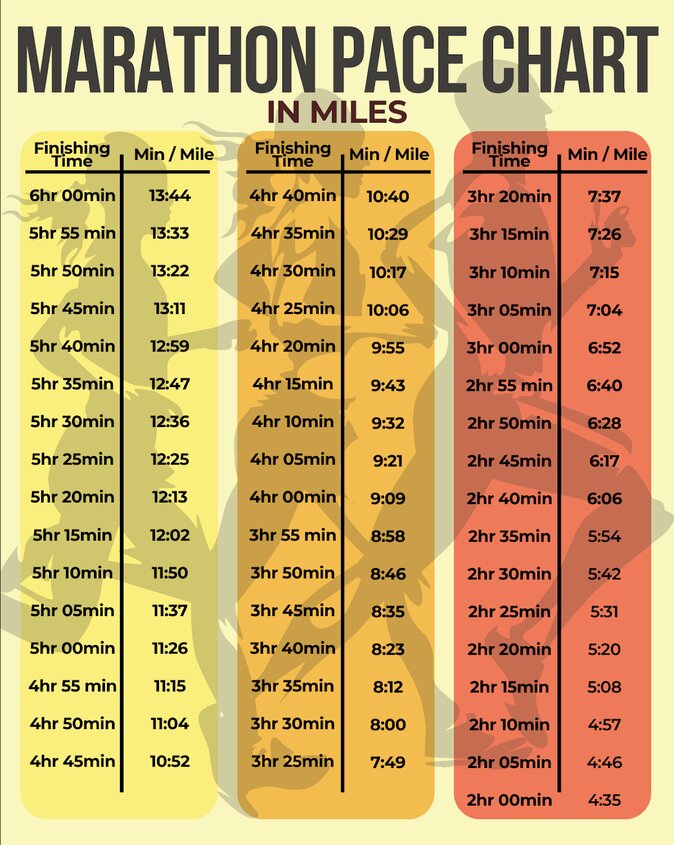
Play the Long Game (idiom) 1: to plan and do things that will help you to be successful far into the future, rather than only thinking about the present or near future. Life is a marathon that requires playing a long game. Being successful in this game involves starting with the end in mind, knowing your why, and working on your plan. One of the most essential lessons from finishing multiple marathons is that your outcome is somewhat predictable. As the marathon chart below shows, a certain amount of minutes per mile must be run to finish at one’s intended finish time. We play the way we train; if you cannot do it during training, executing it on game day will be hard. When you play the long game, you plan your pace and not go too hard at the start.